Rhea ID
Ask a question. Get a signed answer. Never hold the documents.
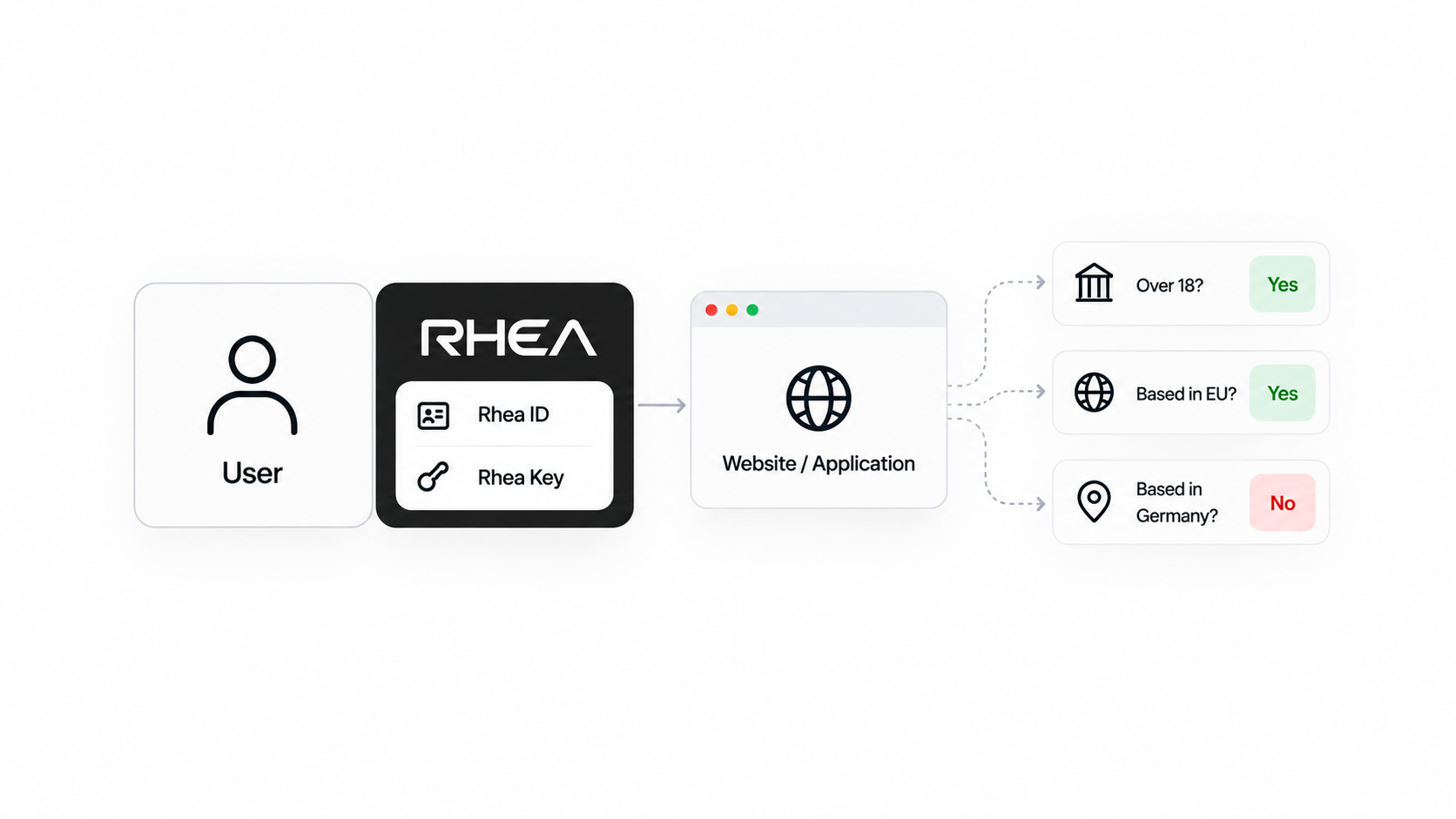
Rhea ID is a boolean-first identity answer engine. A relying party asks one thing — is this person over eighteen, is this the named director, is this individual sanctioned — and receives a cryptographically signed Yes, No or Unknown. The service receives the answer, not the documents. Documents and biometrics are destroyed within seconds of verification.
01 — The problem
Every check creates a new liability.
To answer one question — is this customer old enough, is this counterparty real, is this director who they claim to be — an institution collects a passport scan, a utility bill and a selfie, and then owns them. Forever. Under GDPR. In a breach.
The information needed to make the decision was a single bit. What was actually collected was a permanent archive of somebody's life, duplicated into every institution they ever dealt with.
Every copy is a target. Every retention period is an obligation. Every re-verification repeats the exposure from the beginning.
Prove, don't share
Answer the question. Keep the document.
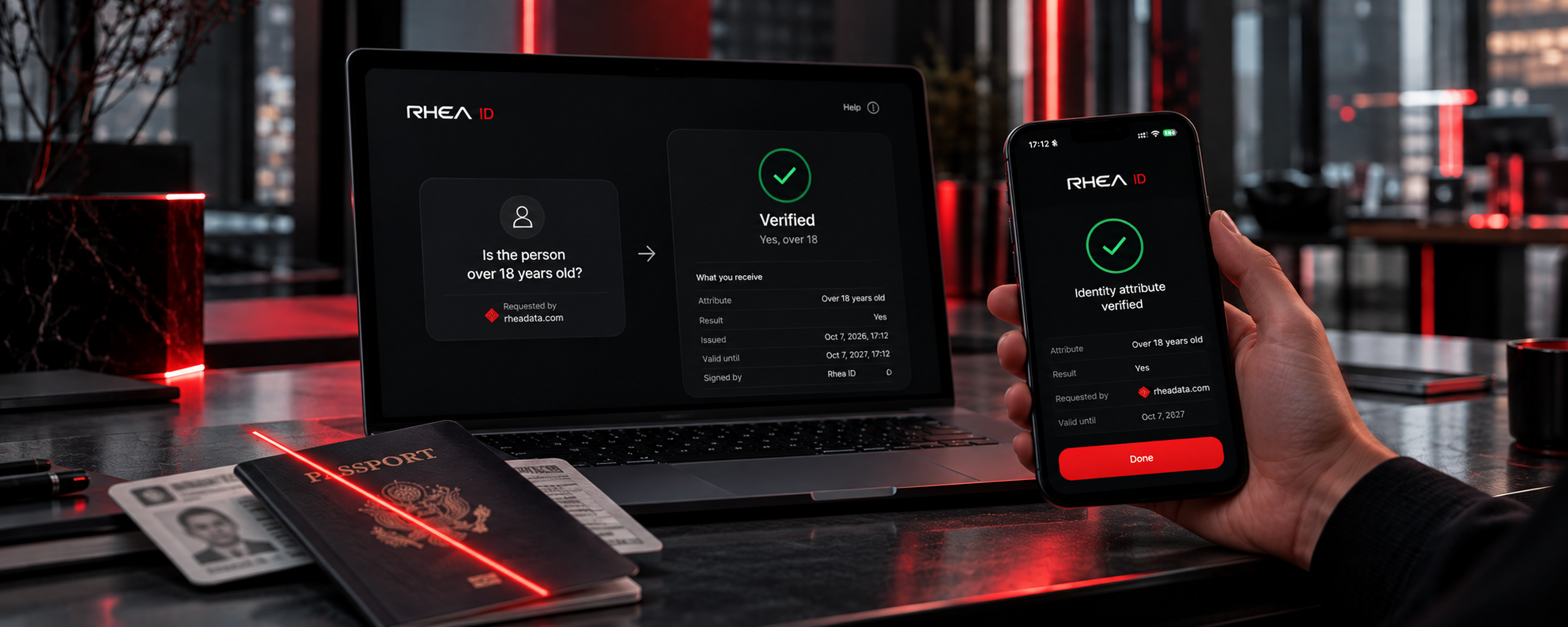
- A service asks: are you over 18?
- Rhea ID answers yes, signed by your Rhea Key
- No document, birth date or address is handed over
02 — The model
Boolean first. Documents never.
Rhea ID is the identity product: a boolean-first answer engine. A relying party asks a question — is this person over eighteen, is this the named director of this company, is this individual on a sanctions list — and receives a cryptographically signed Yes, No or Unknown. It never transfers the underlying documents.
Yes
The fact is verified and holds. The relying party proceeds, and keeps a signed record that it was entitled to.
No
The fact is verified and does not hold. A definite negative is as valuable as a positive, and is far harder to obtain today.
Unknown
The system will not guess. An unverifiable question returns Unknown rather than a probabilistic answer dressed as a fact.
03 — The lifecycle
From document to a signed yes, no, or unknown.
Raw identity documents, passport scans and liveness video exist only in ephemeral processing memory. They are destroyed within seconds of the check. What remains is a signed fact, not a file.
01
Enrolment
The holder enrols once, from their own device. Documents and biometric capture are presented directly to the verification pipeline, never to the relying party that will later ask about them.
02
Liveness verification
A liveness check binds the presented documents to a living human being present at that moment, defeating a replayed photograph, a stolen scan or a synthetic face.
03
Cryptographic shredding
Raw documents, passport scans and liveness video exist strictly in ephemeral processing memory. They are destroyed within seconds of the check. Rhea does not archive them, and cannot produce them later.
04
The encrypted fact vault
What survives is a set of derived, encrypted facts — a date of birth, a nationality, a verified role — held under the holder's own key, not as a copy of the source document.
05
Selective disclosure
A relying party asks one question. The holder authorises one answer. Nothing beyond the answer crosses the boundary — not the document, not the adjacent facts, not the reason for asking.
06
Signed answer
The answer arrives as Yes, No or Unknown, signed. A relying party can verify the signature independently and retain it as evidence, without retaining the person's identity documents.
Minimization is the point of the design. Documents and biometrics are destroyed within seconds; what remains is the signed fact a service asked for.
04 — The question catalogue
Priced by the question, because that is the unit of value.
A question is the billing unit. An unanswerable question returns Unknown and is billed at its class rate, because the cryptographic work was still performed.
| Credits | Question class | Examples |
|---|---|---|
| 1 | Existence and boolean facts | Does a verified identity exist for this subject? Is this account held by a verified person? |
| 3 | Liveness-backed confirmation | Is the person presenting right now the verified holder of this identity? |
| 5 | Precise attributes | Exact age, nationality, verified organisational role or representative status. |
| 10 | Regulatory screening | Sanctions list presence, politically exposed person status. |
Credit bundles
Starter
€199
100K credits
Growth
€999
750K credits
Business
€4,999
4M credits
Enterprise
€19,999
20M credits
HyperScale
€79,999
100M credits
05 — How it composes
Rhea Data · Rhea Key · Rhea ID.
Rhea Data governs the estate: what exists, what may happen to it, and what evidence remains. Rhea Key holds the authority that makes an operation executable. Rhea ID answers who the counterparty is.
Together they close a loop that no single product closes alone: a verified person, holding a key they control, performing a bounded operation on governed data, leaving evidence that verifies without trusting the vendor.
Separating governance, authority and identity limits how much sensitive information any single Rhea product ever handles. Rhea Key and Rhea ID never receive protected file contents. A storage provider receives ciphertext rather than readable content. Rhea ID holds cryptographic facts, not the documents they were derived from.
06 — What Rhea ID is not
Stated plainly, so nothing is assumed.
- Rhea ID is not a government identity document and does not replace a passport, a national ID or a residence permit.
- Rhea ID is not a data broker. It does not sell, rent or aggregate personal information, and it has no underlying documents to sell.
- Rhea ID does not tell a relying party anything it did not ask. There is no bundled profile, no enrichment and no adjacent disclosure.
- Rhea ID never carries Rhea Data protected file contents. The two products are deliberately separate.
Minimization
The documents exist for seconds, and then they do not exist at all.
A breach can only expose what a system retained. Rhea ID is built so that the most sensitive material — the passport scan, the liveness capture — is destroyed within seconds of verification.
0.0s
Presentation
The holder presents documents and a live capture from their own device, directly to the verification pipeline.
~1s
Liveness binding
A liveness check binds the documents to a living person present at that moment, defeating a replayed photograph or a synthetic face.
~3s
Fact extraction
Derived facts — a date of birth, a nationality, a verified role — are encrypted under the holder's own key.
Seconds
Cryptographic shredding
The raw documents and capture are cryptographically shredded and destroyed. Rhea does not archive them.
07 — Clients
Available on the web, on every platform.
Enrolment, the holder vault and the relying-party question API run through the web interface on every platform. The native mobile applications are coming soon and add device-level convenience rather than capability.